

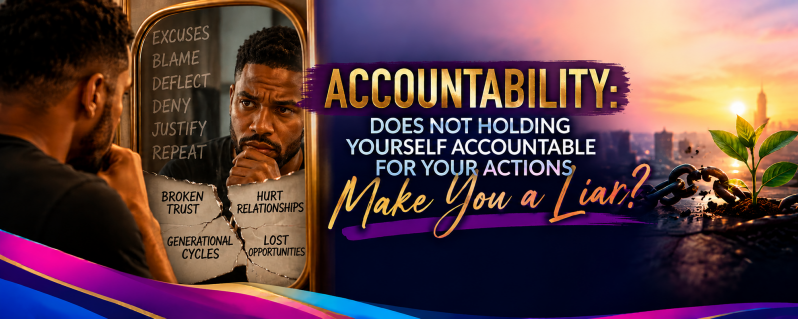
Accountability
By Coach D. Jackson | Watering The Seed
There are some questions that make us uncomfortable because the answer forces us to look at ourselves.
Here’s one:
Does not holding yourself accountable for your actions make you a liar?
My answer?
Yes. Absolutely.
But probably not for the reason you think.
Making a mistake does not make you a liar.
Being wrong does not make you a liar.
Misunderstanding someone does not make you a liar.
Reacting emotionally, making a poor decision, or realizing later that you should have handled something differently does not automatically make you dishonest.
We are human.
We will get things wrong.
The issue begins when we know the truth about our actions but deliberately refuse to acknowledge it.
When we minimize what we did.
When we rewrite the story.
When we leave out the part that makes us accountable.
When we blame someone else for a choice we made.
When we knowingly deny what happened because admitting it would require us to confront ourselves.
That is where accountability and honesty collide.
Because eventually, refusing accountability requires some form of deception.
And sometimes the person we are deceiving the most is ourselves.
Accountability Requires Truth
Accountability begins with a very simple question:
What part of this belongs to me?
Not:
Who started it?
Who hurt me first?
Who was more wrong?
Who should apologize before I do?
The question is simply:
What belongs to me?
Maybe you were provoked.
Maybe somebody treated you unfairly.
Maybe you were hurt.
Maybe you were triggered.
Maybe another person absolutely contributed to the situation.
All of those things can be true.
And you can still be responsible for your response.
That is one of the hardest truths about emotional and spiritual maturity.
Someone else's behavior can explain why you felt what you felt.
It does not automatically excuse what you chose to do with those feelings.
There is a difference between saying:
“This is why I reacted that way.”
and saying:
“Therefore, I am not responsible for the way I reacted.”
One provides context.
The other avoids accountability.
When the Story Keeps Changing
Sometimes dishonesty does not look like an obvious lie.
It can be much more subtle.
It sounds like:
“That’s not exactly what happened.”
“You made me do it.”
“I only said that because you…”
“You misunderstood me.”
“It wasn’t really that serious.”
“Everybody does it.”
“That’s just how I am.”
Or perhaps one of the most common:
“Well, you did something too.”
Notice what happens.
Instead of answering for our behavior, we redirect the conversation toward someone else's.
That is deflection.
And deflection is one of the easiest ways to avoid accountability while still convincing ourselves that we have explained the situation.
But explanation is not the same as ownership.
Imagine someone says:
“I walked out because we were arguing.”
That statement may technically be true.
But perhaps the complete truth is:
“We were arguing because I lied. You confronted me about it. I became defensive, and then I walked out.”
Those are very different stories.
The first story makes the speaker appear almost passive.
The second story recognizes cause and effect.
That is what accountability does.
It puts us back into our own story.
The Danger of Becoming Innocent in Every Story
Pay attention to the stories you tell about your life.
Are you always the person who was wronged?
Are coworkers always jealous?
Are managers always unfair?
Are friends always disloyal?
Are partners always toxic?
Are family members always the ones creating conflict?
Is everyone who confronts you suddenly “negative”?
Certainly, people can experience repeated mistreatment.
But healthy self-reflection still asks:
Is there anything here that I need to learn?
Because if every story we tell conveniently removes our own behavior from the equation, we may be protecting ourselves from something uncomfortable.
Growth.
There is tremendous comfort in believing everyone else is the problem.
Because if they are always the problem, then we never have to change.
But comfort and transformation rarely live in the same place.
At some point, we have to stop examining everybody else's garden and look at our own soil.
Self-Deception Is Still Deception
We usually think about lying as something we do to another person.
But scripture speaks directly about deceiving ourselves.
1 John 1:8 teaches that when we claim to be without sin, we deceive ourselves.
That phrase matters.
Deceive ourselves.
Sometimes we create stories that make it easier to live with our choices.
“I didn't have a choice.”
“I had to say something.”
“They made me angry.”
“I only did it because they treated me badly.”
“I wouldn't have done it if they hadn't…”
But Seeds, there is freedom in changing the language.
Instead of:
“They made me…”
try:
“I chose to…”
That sentence can feel heavy at first.
But it is actually empowering.
Because if you chose something, you can choose differently next time.
If someone else controls every response you make, then you have surrendered your power.
Accountability gives it back.
Accountability Is Not Self-Condemnation
This is especially important for people who already take responsibility for everything.
Accountability is not about carrying everybody's blame.
It is not about apologizing for things you did not do.
It is not about accepting mistreatment because someone tells you that you caused it.
And it is not about becoming the emotional cleanup crew for people who refuse to examine themselves.
Accountability says:
I will own my part.
No more.
No less.
If 20 percent belongs to me, I own my 20 percent.
I do not pick up someone else's 80 percent because they refuse to carry it.
But I also do not throw my 20 percent onto them simply because owning it feels uncomfortable.
That is emotional alignment.
Why Accountability Feels So Threatening
Sometimes people resist accountability because they believe being wrong says something terrible about who they are.
If I admit I lied, am I a bad person?
If I admit I hurt someone, does that mean I am toxic?
If I apologize, does that make me weak?
If I admit you were right, does that mean I lost?
If I own my behavior, will people stop respecting me?
But accountability is not a declaration that you are bad.
It is recognition that you are human.
You can be a good person who made a poor choice.
You can love someone and still hurt them.
You can have good intentions and still cause harm.
You can have trauma and still be responsible for your behavior.
You can have been triggered and still recognize that your response was yours.
Maturity is being secure enough in who you are that correction does not destroy you.
Integrity Is Not Perfection
Sometimes we confuse integrity with never doing anything wrong.
But integrity is not perfection.
Integrity is being truthful when your imperfections are exposed.
A person of integrity can say:
“Yes. I did that.”
“I was wrong.”
“I understand why that hurt you.”
“I should have handled it differently.”
“I want to make this right.”
No speech.
No courtroom defense.
No pulling out emotional receipts from nine Christmases ago.
Just ownership.
Proverbs 28:13 reminds us:
“Whoever conceals their sins does not prosper, but the one who confesses and renounces them finds mercy.”
The lesson is not that perfect people prosper.
The lesson is that transformation begins when we stop hiding.
Apologies Without Accountability
We should also talk about apologies.
Because saying “I'm sorry” is not always the same as taking responsibility.
“I’m sorry you feel that way.”
“I’m sorry if you were offended.”
“I apologize, but you…”
Those statements often protect the speaker more than they repair the relationship.
Real accountability names what happened.
“I'm sorry I lied.”
“I'm sorry I spoke to you disrespectfully.”
“I'm sorry I broke my promise.”
“I'm sorry I betrayed your trust.”
“I'm sorry I failed to follow through.”
Then comes the most important part:
What am I going to do differently?
Because repeatedly apologizing for the same behavior without making any effort to change eventually becomes something other than repentance.
Words matter.
But fruit tells the truth.
Your Life Keeps Receipts
You can say:
“I'm dependable.”
Your commitments have receipts.
You can say:
“I'm a great communicator.”
Your relationships have receipts.
You can say:
“I'm doing everything I can.”
Your habits have receipts.
You can say:
“I've changed.”
Your behavior has receipts.
Eventually, what we consistently do begins telling the story that our words cannot rewrite.
That is why accountability is so important.
It brings our words and our behavior back into alignment.
So, Does Refusing Accountability Make You a Liar?
Here is where I land.
If you genuinely do not recognize what you did, you may lack awareness.
If you remember an event differently, two people may have different perspectives.
If you make a mistake and acknowledge it, you are simply human.
But when you know what happened and deliberately deny it, minimize it, hide it, omit important facts, shift blame, or rewrite the story so that you never have to own your behavior…
you are participating in deception.
And deception is dishonesty.
Even when the lie protects your ego.
Even when others believe your version.
Even when you have repeated the story so many times that you have started believing it yourself.
Truth does not disappear simply because accountability is uncomfortable.
Accountability Is a Pattern Breaker
One of the most powerful reasons to practice accountability is that it interrupts unhealthy Patterns.
You cannot change a behavior you refuse to acknowledge.
You cannot repair something you continue pretending you did not damage.
You cannot break a Pattern you insist you never participated in.
Accountability creates awareness.
Awareness creates choice.
Choice creates change.
And change creates different fruit.
That is why accountability is not punishment.
Accountability is power.
When you own what belongs to you, you gain the ability to change what belongs to you.
Reflection Questions
Take a moment and sit with these questions:
- Where have I been more committed to being right than being honest?
- What behavior have I been explaining instead of changing?
- When I tell the story of my conflicts, do I acknowledge my contribution?
- Is there someone I owe a genuine apology?
- Do I become defensive when someone gives me correction?
- Am I asking others to take accountability while refusing to practice it myself?
- What would change in my life if I became more willing to say, “I was wrong”?
And here's the biggest question:
Who could I become if I stopped defending the behavior that is keeping me from becoming who I say I want to be?
Affirmation
“I choose truth over excuses, ownership over blame, and growth over comfort. I will take responsibility for what belongs to me, release what does not, and make choices that reflect the person I am becoming.”
Final Thought: Seeds, accountability is not about shame. It is about truth. It is about maturity. It is about integrity. And ultimately, it is about transformation.
You don't have to be perfect. But you do have to be willing to tell yourself the truth. Sometimes breaking the Pattern begins with three simple words: "I was wrong."
And transformation begins when those words are followed by four more: "I will do better."
Keep watering the seed. Stay aware. Stay aligned. Stay accountable. And Live a Better Way.
If this post speaks to you, share it with someone who needs to know spiritual maturity is remaining faithful when no one is watching.
Listen to the full podcast episode: EP.37 re You A Liar? "Owning Your Actions" on Spotify, Amazon Music & YouTube Because the issue begins when we know the truth about our actions but deliberately refuse to acknowledge it.
And... tune in to Watering The Seed podcast for more real conversations about healing, alignment, and breaking free.
Drop a comment: “What truth about myself have I avoided because accepting it would require change?" #Accountability
DONATE: Download, and Tune In Now...Podcast Episode:EP.37 Are You A Liar? - Owning Your Actions
Add comment
Comments